Future-Proofing Agentic AI: Why Starting Right Saves Thousands
Why do so many AI initiatives stall? Reports on Agentic AI show a common trend: projects are canceled not because the tech fails, but due to poor data, unclear value, and a lack of "bounded autonomy".
To scale AI responsibly, we don’t need more prompts, we need a better framework. Let's travel back 100 years to find it.
The History of the Loop
The Spark, 1920s: Walter Shewhart, at Bell Labs creates a cycle for manufacturing:
Specification →Production →Inspection. It was the scientific method applied to the assembly line.
The Philosophy, 1950s: W. Edwards Deming takes these ideas to post-war Japan. He evolves the linear process into a circle (Design, Produce, Sell, Redesign), proving that quality is a continuous loop, not a finish line.
Japanese managers simplified this into the PDCA Cycle (Plan-Do-Check-Act), the gold standard for continuous improvement.
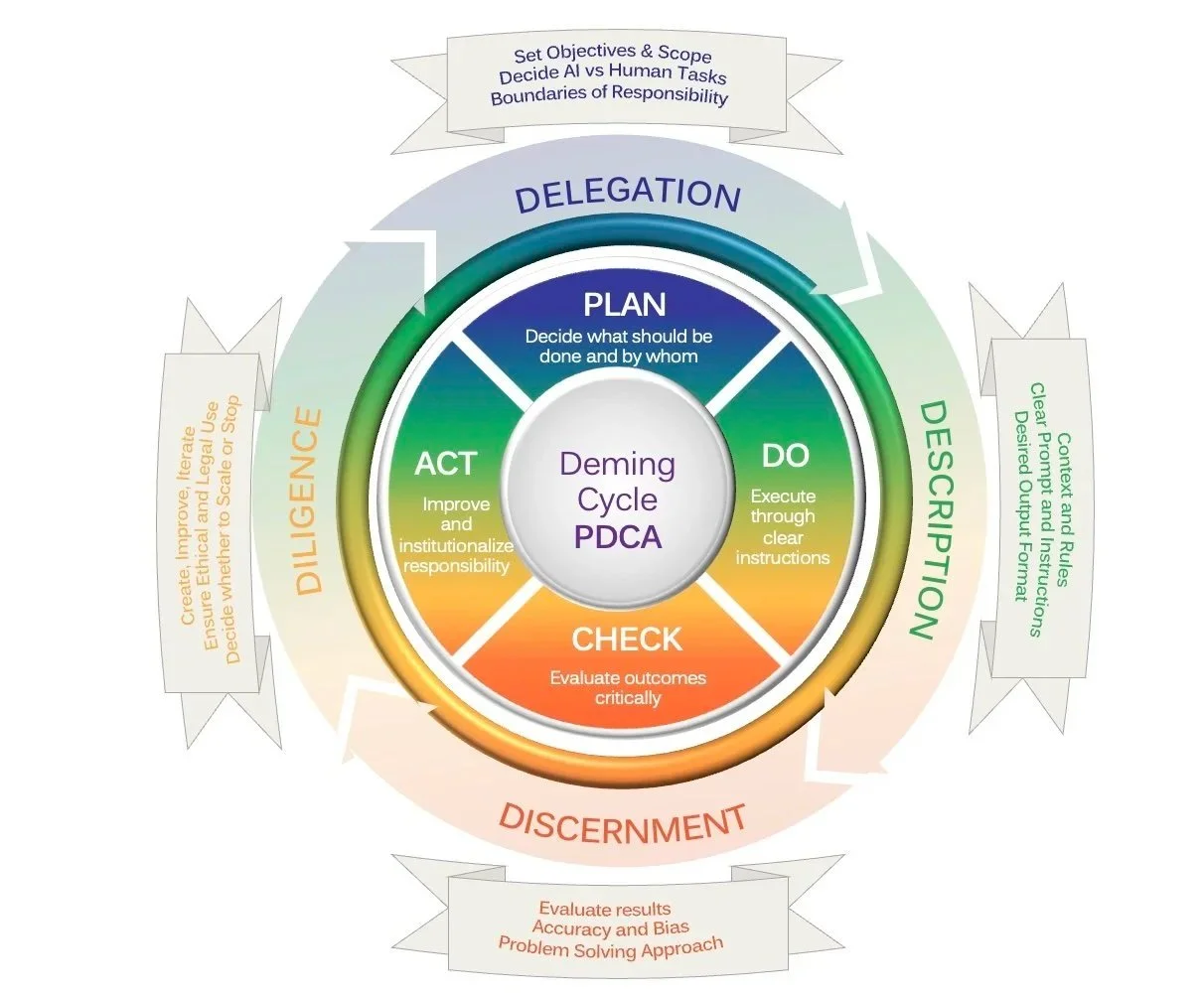
Image © 2026 Village Knowledge Management.
Any use or modification must cite Village Knowledge Management as the original source
Fast Forward: AI in 2026
The challenge today isn't making a widget. It's managing an AI Agent. Just as
Deming taught Japan to focus on systems over individual tasks, modern experts like Professors Rick Dakan and Joseph Feller, with their 4D’s framework for AI Fluency, are shifting the focus from "technical prompts" to core competencies.
Using PDCA for AI Strategy
To increase your chances of success with Agentic AI, you may want to consider to apply the cycle:
PLAN: Define the guardrails and "bounded autonomy". What is the specific value?
DO: Deploy in a controlled, responsible environment.
CHECK: Use rigorous data governance to evaluate the Agent's output.
ACT: Refine the data and scale, or pivot before costs spiral.
How do this works in a practical environment?
Consider a multi-step HR onboarding agent:
Plan: Scope the workflow so the agent gathers info, triggers IT/HR tasks, and sends status updates, while humans approve exceptions or unusual requests.
Key Task: Ensure ownership. Who owns each decision and output: the agent, a specific human role, or a shared checkpoint?Do: Pilot on a subset of new hires, with human checkpoints on access, payroll, and policy acknowledgments.
Key Task: Balance efficiency and risk. Is the distribution of work between AI and humans reducing legal, ethical, and reputational risk while still giving a meaningful efficiency gainCheck: Measure time‑to‑ready, error rates, and satisfaction from new hires and HR; note where human decisions were still essential.
Act: Standardize which steps are fully automated, which require approval, and how the agent escalates unclear cases.
Key Task: Are Check/Act stages being used to actually improve prompts, guardrails, and human workflows over time, or are they being treated deployment as a one‑off event?
The Lesson? Success in the age of AI isn't about the fastest "Do". It's about the strongest "Check."